UK Student Finance and The Curse of Egalitarianism
There's been some chatter recently in the UK about student loan balances, repayments and possibly reform/forgiveness. I have some thoughts about that. Spoiler: my main thought is that like most government run programs, universities and loans in the UK are highly egalitarian. This also makes that terrible in a bunch of ways.
How Student Financing Works
First, loans.
- Who takes out the loans? Almost everyone who goes to university takes, somewhere around 95%[1].
- Who provides the loans? These loans are almost all provided by the state, via the Student Loans Company or SLC for short. SLC is owned and funded by the UK government. The money it lends out comes from the Treasury and its book sits on the government balance sheet.
- What's the interest rate? It's the same rate for everyone who takes out a loan. The rate is based on inflation, but the specifics vary a bit based on start year[2].
- What's the repayment? You repay a flat 9% of your gross income above certain fairly low income threshold of 25k[3].
- What's the recovery rate for the taxpayer? In net present value terms, the repayment rate is around 70%[4].
Second, fees. It's pretty simple.
- Undergrad course fees are capped by law. Almost all universities charge the max amount allowed, so the fee cap is basically equivalent to fees charged
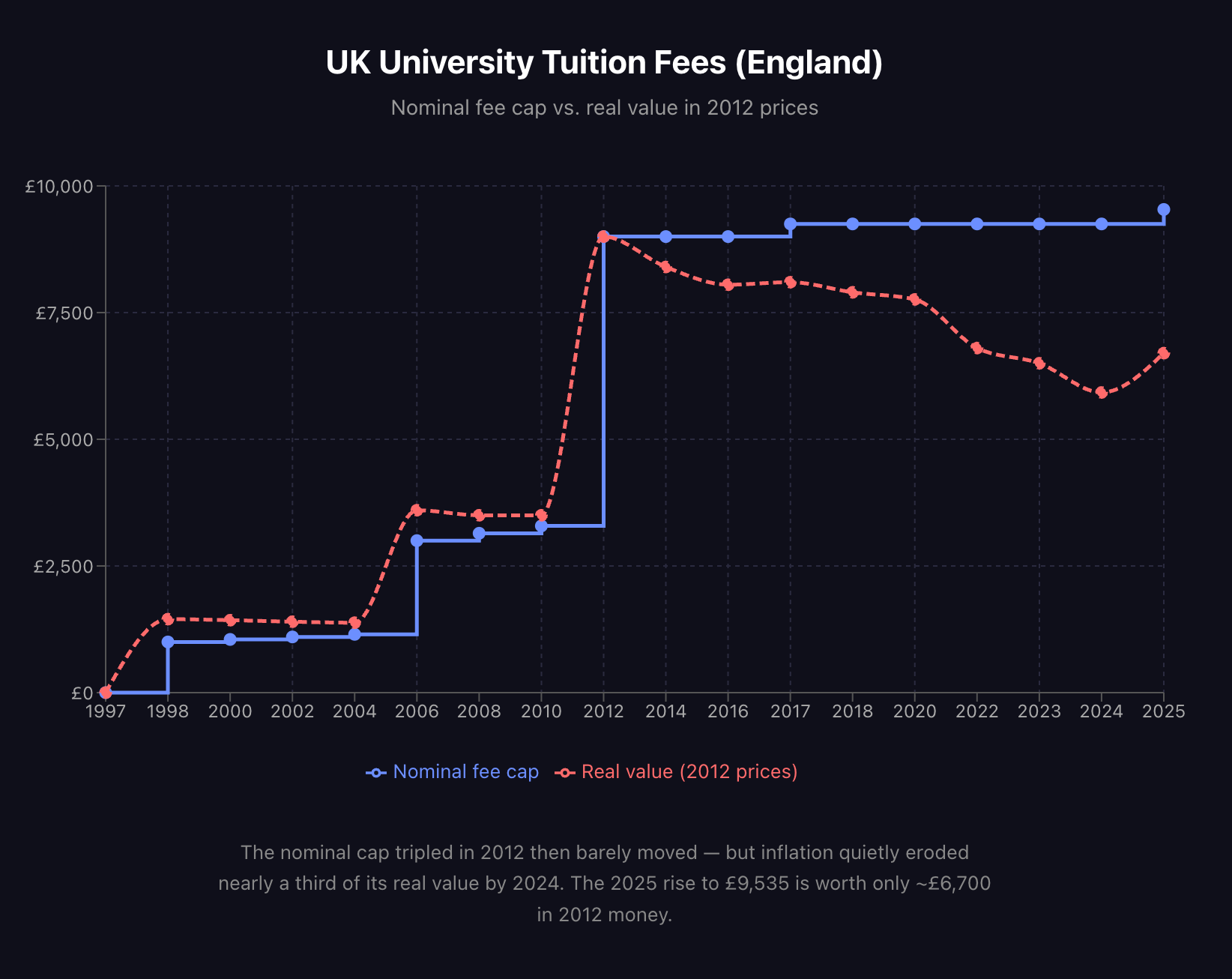
- Fees jumped up from 3k to ~9k in 2012 (the year I started uni). They stayed fairly flat since then in nominal terms which means they fell in real terms.
Third, university more generally
- Universities fund undergrad courses from a combination of fees, grants (specifically the Strategic Priorities Grant) and cross-subsidization
- Different courses cost different amounts of money to deliver. Humanities/social sciences are cheap. Hard sciences are much more expensive. Specialist courses such as dentistry, medicine, veterinary etc... are again even more expensive. Grants reflect this with the more expensive courses above receiving the lion's share of grant funding.
- Both grants and fees are basically the same for all universities regardless of performance/quality.
- Teaching a UK undergrad often costs more than combined fee + grant income. Uni's often cross-subsidize undergrad programs from international student fees (which are not price controlled) or research income.
Thoughts
A lot of the discourse on this focuses on the plight of students who took on vast loans at 18 for terrible degrees. They're then stuck doing a low income job but with 50k - 100k of debt they'll never realistically pay back hanging over them. Sure they don't actually have to pay it back as it's written off after a few decades, but they still basically pay an extra 9% tax on all income over 25k for most of their working lives.
I do have thoughts here. It seems bad that teachers, uni advisors, the state etc... all push 18 years olds to take on massive debt you cannot discharge through bankruptcy. It also seems bad that taxpayers, many of whom never went to uni, bail out unsuccessful graduates who often chose degrees that they could have known have terrible employment prospects. Still, I think what's more striking here is that the system is outright crazy in a bunch of ways.
- All universities charge the same amount. An amazing university with internationally renowned teaching can by law charge only 9k, the same amount as a terrible non-name uni with atrocious employment outcomes
- All students get the same loan. A person getting CCC at A level and going to a shit tier uni to study marketing will get the same financial support as someone going to Oxbridge with straight A*
- Your eligibility for a loan is not linked in any way to your prospects of repaying it
- University fees were capped at a fixed nominal amount, meaning they went down every year in real terms. This was somewhat fixed recently and they should be inflation linked going forward.
In a rational system, you'd expect that signals would flow through the market in both directions. Universities would be able to charge more the better their courses were. Loan providers would compete to identify which students and courses would be most economically productive and hence able to repay their loans post graduation. Students would be provided with a wide variety of courses and loan providers and the market would naturally nudge them towards a study program that is economically rational, both for them individually and for society in terms of resource allocation. There are some problems with this and I'll probably do a follow up post on how to do a market based solution while also dealing with signaling/sorting/externalities.
I tend to think that state run systems often fall prey to the same problem. Bryan Caplan would call it social desirability bias. I think I call it the curse of egalitarianism. Either way the core issue is that if we want good outcomes we need to accept two things
- ranking and assessing goods/people
- allocating more resources to the most successful and letting the least successful die (for firms and orgs) or drop out (for students)
Both of these are things that political systems are often unwilling to do. This is understandable. Public choice theory 101 is that in a democracy where most people and institutions have similar levels of voice the government's distribution of resources will be fairly egalitarian and will tend to avoid causing incumbents to suffer.
- https://www.gov.uk/government/statistics/student-support-for-higher-education-in-england-2025↩︎
- 2012 - 2023 starters: For a given year RPI + 0% - 3% depending on borrower income in that year. 2023 - Present: RPI↩︎
- ~28k for 2012-2023 starters↩︎
- https://explore-education-statistics.service.gov.uk/find-statistics/student-loan-forecasts-for-england/2024-25#section-student-loan-costs-to-government-cost-to-taxpayer↩︎
Member discussion